
Last updated June 2026 · 14 min read
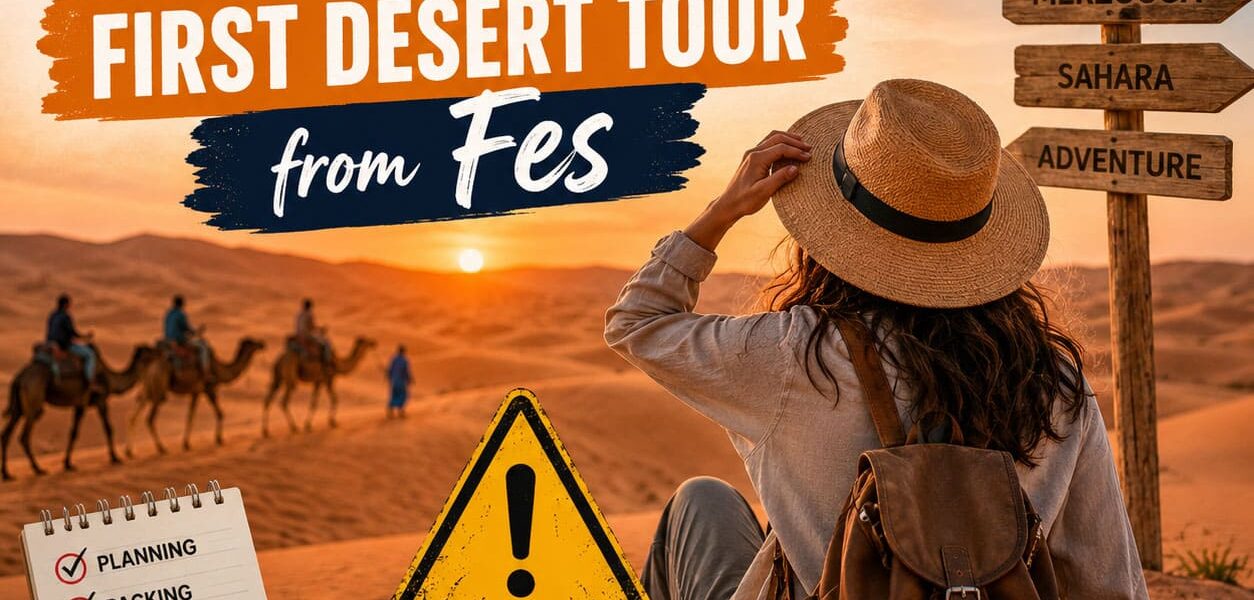
Standing on top of a 100-metre dune at sunrise, watching the Sahara turn from violet to gold while a glass of mint tea cools in your hand, is the kind of memory that outlives the whole trip. That moment is exactly why a desert tour from Fes is one of the great highlights of visiting Morocco. But here’s the honest part: whether you walk away with that memory or a frustrating, rushed, overpriced day in a minivan often comes down to a handful of choices you make before you ever leave the city.
That’s what this guide is for. These are the 10 mistakes to avoid on your first desert tour from Fes — the ones we see first-time travellers make again and again, drawn from more than a decade of running tours across the route. Avoid them, and the journey from the medina to the Erg Chebbi dunes becomes one of the most unforgettable things you’ll ever do.
Mistake 01Booking the Cheapest Tour Without Checking What’s Included
The lowest price is the most expensive mistake on this list, because the gap between a €45 “shared budget tour” and a well-run private trip is almost never about greed — it’s about what quietly got removed to hit that number.
A suspiciously cheap desert tour usually trims the things you can’t see on a booking page: an older vehicle with worn tyres on mountain roads, a camp with shared bathrooms and thin blankets, a rushed driver doubling as a “guide,” and meals that are an afterthought. None of it shows up until you’re standing in it.
Here’s what actually separates a good tour from a cheap one:
- Private vs shared. On a shared tour you travel on the group’s schedule — its stops, its pace, its bathroom breaks. A private tour follows yours. For couples, families and anyone over 50, that flexibility is usually worth the difference alone.
- Camp quality. “Desert camp” covers everything from a basic tent with a shared latrine to a standing tent with a real bed, en-suite bathroom and hot water. Ask exactly which one you’re booking.
- Transport. A modern 4×4 or minivan with air conditioning and a careful driver matters enormously on a 7-hour mountain route. This is not the place to save €20.
- Meals. Confirm what’s covered. A proper tour includes dinner and breakfast at camp, usually a tagine cooked on site — not a granola bar handed over at sunset.
- Guide quality. A licensed, English-speaking driver-guide who knows the region turns a long drive into a story. A silent driver turns it into a commute.
Mistake 02Choosing the Wrong Tour Duration
Tour length is the single biggest factor in how the Sahara feels — and the most common thing first-timers get wrong. Too short and the desert becomes a checkbox; too long and you’re paying for time you didn’t need. Here’s how the main options compare.
| Duration | Best for | What you get | The trade-off |
|---|---|---|---|
| 2 days | Tight schedules, returning to Fes | One night in the dunes, a camel trek and sunrise | A lot of driving for one desert night; feels rushed |
| 3 days | Most first-time visitors | The full crossing, gorges, valleys, a proper night at camp, ending in a new city | Genuinely none — this is the sweet spot |
| 4 days | Slow travellers, photographers, families | Everything above plus extra stops, a slower pace and a second base | Costs more; needs the calendar space |
For most people landing in Fes, the three-day route is the one that does it all. You cross the Middle and High Atlas, stop in the Ziz Valley and the gorges, spend a real night under the stars, then wake up and continue to a different city rather than backtracking. If you’re ending your trip in the south, the classic Fes to Marrakech Desert Tour in 3 Days threads the desert into the journey instead of treating it as a detour — you finish in Marrakech with the Sahara already behind you.
Travelling with kids or simply want to slow down? The 4 Days Fes to Marrakech Desert Tour adds breathing room for extra stops and a gentler pace. And if you’d rather loop back toward Fes, the Fes to Merzouga Desert Tour keeps the focus tight on Erg Chebbi.
Mistake 03Packing the Wrong Clothing
The desert is not “hot.” It’s hot, and then it’s surprisingly cold, often on the same day. Travellers who pack only for the heat are the ones shivering at camp after dark. The fix is simple: layers.
- Layering is everything. A breathable base, a light long-sleeve, and a warm fleece or jacket for nights cover almost every season. Even in spring, evenings at camp can drop sharply once the sun is gone.
- Closed walking shoes. You’ll be on rocky ground, in gorges, and around the camp. Trainers or light hiking shoes beat sandals everywhere except the dune walk itself, where bare feet are best.
- Sun protection. A wide-brim hat or scarf, high-SPF sunscreen and proper sunglasses are non-negotiable. The Saharan sun is stronger than it feels.
- Camera gear. Bring more memory and battery than you think — golden hour over the dunes will fill a card fast. A microfibre cloth handles dust.
- Portable charger. Camps run on solar and generators with limited evening power. A power bank keeps your phone alive for that sunrise shot.
- A small daypack. You won’t haul a suitcase up a dune. Pack an overnight bag for camp and leave the big case in the vehicle.
Quick packing checklist
- Warm layer or fleece (yes, even in summer)
- Closed walking shoes + flip-flops for camp
- Scarf or shemagh (sun, wind and dune dust)
- Sunglasses, hat, SPF 30+
- Refillable water bottle
- Power bank + charging cables
- Lip balm and moisturiser (dry air)
- Small cash in dirhams (see Mistake 8)
- Any personal medication
Mistake 04Underestimating the Driving Distances
On a map, Fes to Merzouga looks like a quick hop. In reality it’s a full day across mountains, and travellers who don’t expect that are the ones grumbling by lunchtime. Knowing the route in advance turns those hours from “are we there yet” into the best part of day one.
| Leg | Approx. time | What’s there |
|---|---|---|
| Fes → Ifrane | ~1 hr | The “Switzerland of Morocco” — alpine streets and lakes |
| Ifrane → Azrou | ~25 min | Cedar forest with wild Barbary macaques |
| Azrou → Midelt | ~2 hrs | High plateau crossing; apple country and lunch stop |
| Midelt → Erfoud | ~3 hrs | Ziz Valley gorges and palm oases — the scenic highlight |
| Erfoud → Merzouga | ~1 hr | The last stretch to the Erg Chebbi dunes |
All told, expect roughly 7 to 8 hours of driving on day one, plus stops. That’s exactly why a multi-day trip works better than a same-day dash: the time is the point. Each stop — the macaques at Azrou, the cedar forest, the dramatic Ziz gorges — is a reason to be on that road in the first place.
Mistake 05Not Choosing a Reputable Local Tour Operator
This is the mistake that quietly determines all the others. A reputable local operator gets the vehicle, the camp, the timing and the safety right because they live the route every week — and because their reputation depends on it.
Experienced local companies offer three things a faceless online aggregator can’t. First, safety: drivers who know the mountain roads, weather windows and conditions on the day. Second, authenticity: genuine connections to camp owners, Berber families and the right sunset spot that aren’t on any map. Third, accountability: someone reachable who answers when plans change.
That’s the gap a company like Asara Morocco Tours is built to fill. Berber-owned and based in Marrakech since 2014, the team has run more than 900 tours across these exact routes, and the small details — knowing which camp has the best beds, which viewpoint catches first light, which café in Midelt does the best lunch — come from running them in person, not booking them from a screen. You can browse the full range of Desert Tours from Fes to see how the routes connect.
Mistake 06Skipping the Camel Trek
Some travellers, worried about comfort or short on time, skip the camel trek and ride a 4×4 to camp instead. Most of them regret it. Crossing the Erg Chebbi dunes by camel at sunset, the long shadows stretching across the sand and the only sound the soft pad of hooves, is the single most iconic moment of the whole trip — the postcard you came for, lived in real time.
It’s also gentler than people fear. The camels are led at a walking pace by an experienced cameleer, the ride to camp typically lasts 45 minutes to an hour, and the sunset timing means you arrive as the desert glows. It is, in the most literal sense, a once-in-a-lifetime experience.
Mistake 07Ignoring Desert Weather
The Sahara has seasons, and they’re dramatic. Picking the wrong month — or simply not knowing what to expect — turns a magical trip into an endurance test. Here’s the honest breakdown.
| Season | Days | Nights | Verdict |
|---|---|---|---|
| Spring (Mar–May) | Warm, 25–30°C | Cool, 10–15°C | Ideal — wildflowers and clear skies |
| Summer (Jun–Aug) | Very hot, 40–45°C+ | Warm | Intense; go for sunrise/sunset, rest midday |
| Autumn (Sep–Nov) | Warm, 25–32°C | Cool | Excellent — quieter and comfortable |
| Winter (Dec–Feb) | Mild, 15–20°C | Cold, near 0°C | Beautiful days, very cold nights — pack warm |
The best months are March to May and September to November. You get warm, comfortable days for the dunes and cool but bearable nights at camp. Summer is doable if you respect the heat; winter days are gorgeous but the nights genuinely bite, so warm layers are essential.
Mistake 08Not Bringing Cash
The Sahara runs on cash, and travellers who assume they can tap a card everywhere get caught out. Once you leave Fes, card machines become rare and unreliable.
- ATMs thin out fast. Withdraw dirhams in Fes, or top up at the last reliable machines around Midelt or Erfoud. Don’t count on Merzouga.
- Tips are customary. A tip for your guide and cameleer is expected and appreciated — and you’ll want small notes ready.
- Small villages are cash-only. Roadside stalls, co-operatives and local cafés rarely take cards.
- Souvenirs and drinks. Fossils, rugs, scarves and that cold drink at a viewpoint all want cash, ideally in small denominations.
Mistake 09Expecting Luxury Everywhere
The desert can be genuinely luxurious — but it’s a different kind of luxury than a city hotel, and mismatched expectations are a common source of disappointment. The magic is in the setting, not in five-star plumbing.
Modern luxury desert camps near Merzouga are remarkable: standing tents with proper beds and crisp linens, en-suite bathrooms with hot showers, candlelit dinners, rugs underfoot and Berber drumming under a sky thick with stars. That’s real comfort, and it’s available.
What it isn’t is a downtown hotel. Power may pause overnight, water is precious, and Wi-Fi is patchy by design. Go in understanding that — embracing the remoteness rather than fighting it — and a luxury camp becomes one of the most romantic nights of your life. Expect a Hilton in the sand and you’ll miss the point.
Mistake 10Missing the Cultural Experiences
The final mistake is treating the desert as scenery and missing the people who make it alive. The landscape is unforgettable, but the culture is what travellers talk about for years.
- Berber music. Evenings at camp often end around a fire with drums and call-and-response singing. Join in — it’s meant to be shared.
- Local food. A tagine slow-cooked at camp, fresh bread, sweet mint tea poured from height — the food is part of the story, not a refuel.
- Nomad families. Many tours include a respectful visit with a nomadic family, a window into a way of life that’s vanishing.
- Fossils. This region was once an ocean. The fossil workshops near Erfoud reveal ammonites and trilobites hundreds of millions of years old.
- Traditional markets. Roadside souks sell dates, spices, rugs and crafts straight from the makers.
- Hospitality. Above all, the Berber tradition of welcome — the endless tea, the easy generosity — is the thing you’ll carry home.
Best Time to Visit the Sahara
To put the seasons in one line: aim for spring or autumn. March through May and September through November deliver warm days, manageable nights and the clearest skies for stargazing. April and October are arguably perfect. Summer rewards early risers who shelter from the midday heat; winter offers crisp, sunny days and dramatically cold nights that make a warm camp feel earned. There’s no truly bad time — only different ones to pack for.
What Happens During a Typical Desert Tour
If you’ve never done this before, here’s the shape of it. Day one is the great crossing: you leave Fes early, climb through Ifrane and Azrou, stop for the macaques and the cedar forest, cross the high plateau to Midelt for lunch, then descend through the Ziz Valley’s gorges and oases to Erfoud, reaching the dunes by late afternoon. You swap the vehicle for a camel and ride into Erg Chebbi for sunset, arriving at camp for dinner, music and stars.
Day two begins with a sunrise over the dunes — set an alarm, it’s worth it — then continues your route, whether that’s onward to Marrakech through the Todra Gorge and Dades Valley, or back via a different road. A good operator shapes these days around you rather than a rigid script.
Sample 3-Day Itinerary
-
Fes → Merzouga Dunes
Cross the Middle Atlas via Ifrane and Azrou (cedar forest, macaques), lunch in Midelt, then the Ziz Valley to Merzouga. Sunset camel trek into Erg Chebbi and a night at a desert camp with dinner and music.
-
Sunrise → Todra Gorge → Dades Valley
Watch the sun rise over the dunes, then travel west through palm oases to the towering Todra Gorge, ending the day among the rose-coloured rock formations of the Dades Valley.
-
Dades → Aït Ben Haddou → Marrakech
Follow the Road of a Thousand Kasbahs to the UNESCO-listed ksar of Aït Ben Haddou, cross the High Atlas over the Tizi n’Tichka pass, and arrive in Marrakech by evening.
This is the backbone of the Fes to Marrakech Desert Tour in 3 Days — and on a private trip, every stop can be lengthened, shortened or swapped to suit you.
Why Private Desert Tours Offer Better Value
“Private” sounds like the pricier option, and per head it sometimes is — but value isn’t the same as cost. On a private desert tour you control the pace, the stops and the timing. You linger at the gorge that captivates you and skip the one that doesn’t. You eat when you’re hungry, not when sixteen strangers are. You reach viewpoints before the crowds because your driver isn’t shepherding a full minibus.
For families, couples and older travellers especially, that flexibility is the value. The Sahara is a long way to go to be rushed — a private trip makes sure the hours you’ve invested actually become the experience you wanted.
Why Travellers Trust Asara Morocco Tours
Trust in this business is earned one well-run trip at a time. Asara Morocco Tours is a Berber-owned company based in Marrakech, running private desert tours and tailor-made Morocco itineraries since 2014. The team’s edge is simple: they’re local, they drive these roads themselves, and they’ve done it more than 900 times.
A track record, not a tagline
Berber-owned and Marrakech-based since 2014, specialising in authentic private desert tours, cultural experiences and tailor-made itineraries across Morocco.
5.0★From 82+ Tripadvisor reviews
100%Private & tailor-made
Photography Tips for the Sahara
- Shoot the golden hours. The dunes are flat and harsh at midday but sculptural at sunrise and sunset, when low light carves out every ridge and ripple.
- Find a clean ridge. Walk a few minutes from camp to a dune with untouched sand — footprints in the foreground date a photo instantly.
- Add scale. A lone figure or a camel against the dunes shows just how vast the landscape is.
- Protect your gear. Fine sand gets everywhere. Keep a microfibre cloth handy and change lenses inside a bag, not in the open.
- Stay up for the stars. With near-zero light pollution, a tripod and a 15–25 second exposure capture the Milky Way beautifully.
Wildlife You May Encounter
The Sahara looks empty but isn’t. Along the route and around the dunes, keep an eye out for:
- Barbary macaques in the cedar forest near Azrou — the trip’s first wildlife highlight.
- Dromedary camels, your transport into the dunes and a constant presence at camp.
- Desert birds like larks, wheatears and the occasional bird of prey wheeling overhead.
- Lizards and small reptiles darting between rocks in the cooler hours.
- Desert foxes (including the tiny fennec) — shy and mostly nocturnal, but a lucky sighting near camp.
Desert Camp Etiquette
- Ask before photographing people. Guides, cameleers and nomad families deserve the courtesy of a yes.
- Conserve water. Every litre at camp was carried in. Short showers, no waste.
- Respect the quiet. Sound carries far in the dunes — keep music to the shared fire, not your tent.
- Dress modestly around camp and villages, in keeping with local custom.
- Tip fairly. Your cameleer and camp staff work hard in a remote place; a tip in cash is the right thank-you.
Responsible Tourism Tips
The Sahara and its communities are fragile, and good travellers leave them better than they found them.
- Choose local operators who employ Berber guides and staff, keeping tourism income in the region.
- Take your litter with you — there’s no bin truck in the dunes.
- Buy direct from co-operatives and artisans rather than middlemen.
- Don’t take fossils or rocks from protected sites; buy from licensed workshops instead.
- Be a considerate guest in small communities — your behaviour shapes how the next travellers are received.
Expert Advice: What Local Guides Know That Guidebooks Don’t
A few hard-won tips you’ll rarely find in a guidebook:
- Leave Fes early. A 7:30–8:00 am start means you reach the dunes with daylight to spare and beat the heat through the mountains.
- Sit on the right side heading south through the Ziz Valley for the best gorge and oasis views.
- Bring a head torch for camp — it frees your hands for tea and stars after dark.
- Try the dunes barefoot at sunrise, before the sand heats up. It’s cool, silky, and unforgettable.
- Drink more water than you think you need. The dry air dehydrates you quietly, long before you feel thirsty.
- Don’t over-plan day two. The best moments — an unscheduled tea with a shepherd, a viewpoint you didn’t know existed — happen in the gaps.
First-Time Traveller Checklist
Print this, screenshot it, or just tick it off mentally before you go.
Frequently Asked Questions
Is a desert tour from Fes worth it?
Absolutely — for most visitors it’s the highlight of their entire Morocco trip. The crossing of the Atlas, the camel trek into Erg Chebbi, a night under the stars and the Berber hospitality combine into something you simply can’t get anywhere else. Avoid the common mistakes in this guide and it becomes unforgettable.
How many days should I choose?
Three days is the sweet spot for first-timers. Two days is fine if you’re short on time but feels rushed, while four days adds a relaxed pace ideal for families and photographers. The three-day route gives you the full crossing and a proper night in the dunes without backtracking.
Is camel trekking difficult?
Not at all. The camels are led at a slow walking pace by an experienced cameleer, and the ride to camp lasts under an hour. The only slightly bumpy parts are when the camel stands and kneels — hold the saddle and lean with the motion. Most people find it gentle and magical.
Can children join a desert tour?
Yes, families are very welcome and kids usually love the camels and the dunes. A private tour works best with children because you control the pace and breaks. A four-day itinerary with a gentler rhythm is often ideal for young travellers.
Can seniors join?
Definitely. Comfortable vehicles, flexible timing and the option to ride a 4×4 to camp instead of a camel make these tours very accessible. A private tour is strongly recommended so the pace fits you rather than a group.
Are private tours better than shared tours?
For most travellers, yes. A private desert tour lets you set the pace, choose your stops and avoid crowds, and it’s far more comfortable for families and older visitors. Shared tours are cheaper but follow a fixed group schedule.
What should I wear in the Sahara?
Layers are key: breathable clothes for hot days and a warm fleece or jacket for cold nights, plus closed walking shoes, a sun hat or scarf, and sunglasses. Even in summer, evenings at camp can feel cool once the sun sets.
Is Merzouga safe?
Yes. Merzouga and the Erg Chebbi region are well established for tourism and considered very safe. The main thing to manage is the environment — heat, sun and cold nights — which a reputable local operator helps you prepare for.
How cold is the Sahara at night?
It varies by season. Spring and autumn nights are cool, around 10–15°C. Winter nights can drop close to freezing, while summer nights stay warm. Camps provide blankets, but packing a warm layer is always wise.
Can vegetarians join, and is the food suitable?
Yes. Moroccan cuisine is very vegetarian-friendly — vegetable tagines, couscous, salads and fresh bread are staples. Just let your operator know your dietary needs in advance and camps will happily accommodate vegetarian, vegan and other requirements.
Do I need to bring cash?
Yes. Once you leave Fes, ATMs and card machines become scarce. Withdraw dirhams before you go for tips, souvenirs, drinks and purchases in small villages, ideally in small denominations.
How do I book a desert tour from Fes?
Choose a reputable local operator, confirm exactly what’s included, and book ahead — especially in spring and autumn. You can explore routes and options through Asara’s Desert Tours from Fes to find the itinerary that fits your dates and pace.
Your Sahara, Done Right
A desert tour from Fes can be the single best thing you do in Morocco — or a long, hot disappointment. The difference almost always comes down to the choices in this guide. Avoid the cheapest-tour trap, give the desert enough days, pack for both heat and cold, respect the distances and the seasons, carry cash, set realistic expectations, and lean into the culture rather than just the scenery. Do those things, and the Erg Chebbi dunes will hand you a memory that lasts a lifetime.
These really are the 10 mistakes to avoid on your first desert tour from Fes, and now that you know them, you’re already ahead of most first-time travellers. The rest is just the joy of going.
Ready to see the Sahara properly?
Explore Asara Morocco Tours’ carefully designed private desert itineraries — from the dunes of Merzouga to the road into Marrakech — and travel with a Berber-owned team that knows every stop in person.
Browse Desert Tours from Fes
Questions about dates or routes? WhatsApp +212 718 785 883 · asaramoroccotours@gmail.com